
The starting point: a great roof plumber the phone wasn't ringing for
A few years ago, Billy was running BM Roof Plumbing on his own — a one-man operation. He was a good roof plumber, but being good at the trade and having a steady stream of work coming in are two very different things. Like most local businesses, the calendar was filled almost entirely by referrals.
Referrals are a fantastic source of work, and the goal was never to replace them. But referrals aren't a strategy — they're the bonus you earn for doing a great job for someone else. They come when they come, and you can't turn them up when the calendar gets quiet. The single biggest challenge BM Roof Plumbing faced early on is the same one almost every small business hits: getting the phone to ring on demand.
That flow of work matters for more than just cash. Every lead is a rep — another chance to practise quoting, pricing, talking to customers and closing the job. The more leads come through, the faster you get better at running the business. So the first job wasn't marketing for the sake of it. It was building a reliable pipeline of work so Billy could grow into a business owner, not just stay a busy tradesman.
The strategy: be where people search, the moment they have a problem
Most people don't scroll Instagram looking for a roofer. When water's coming through the ceiling, they go to Google — right now, with money in hand. So the whole strategy comes down to one idea: show up in search the moment someone has a problem you can solve, then make it easy for them to choose you.
There's no dancing for the algorithm and no going viral required. We built three things that work together — a Google Business Profile, a website built to be found, and problem-based Google Ads — and let consistency do the heavy lifting.
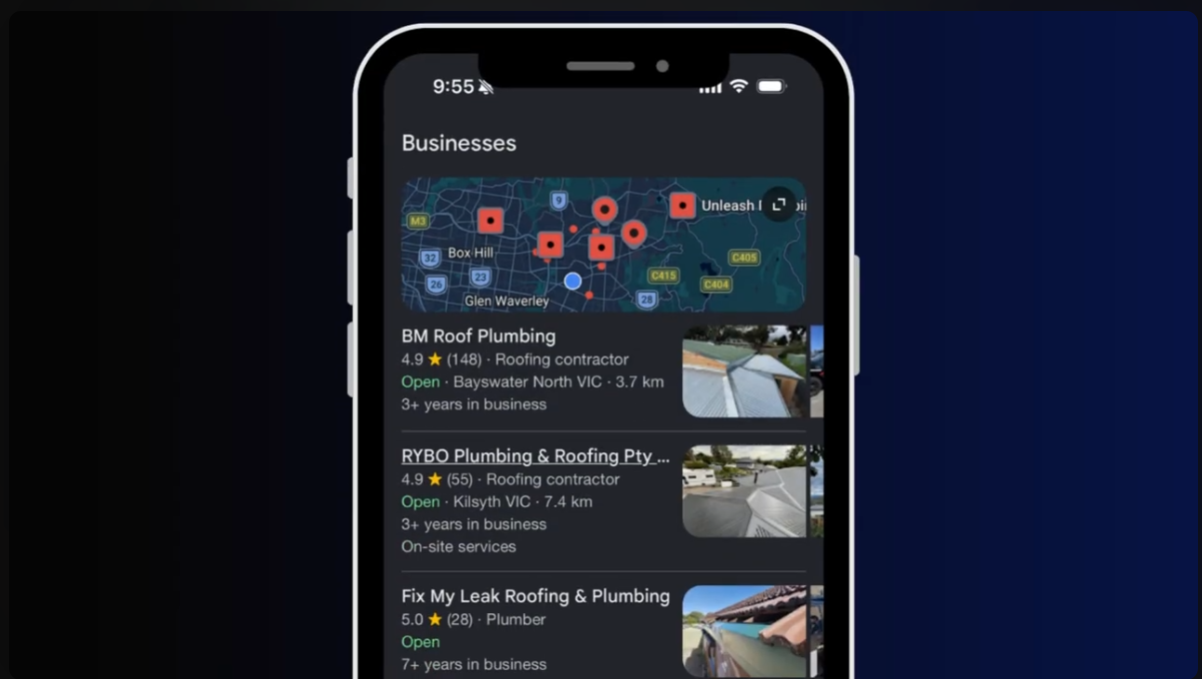
Step 1 — The Google Business Profile (and 150+ reviews)
The Google Business Profile is a free tool, and it's the fastest way to start showing up in the local "map pack" results. But the profile itself isn't what wins — reviews are. Billy pushed hard on this and built up over 150 five-star reviews, and it did two things at once:
- It pushed BM Roof Plumbing higher in the local search results, in front of more people.
- It made him the obvious choice once he got there — when a customer is comparing three roofers, the one with 150 reviews wins against the one with five, almost every time.
This is the part that compounds. Every job done well becomes another review, every review lifts the rankings, and better rankings bring more jobs. It's slow at first and then very hard for competitors to catch.
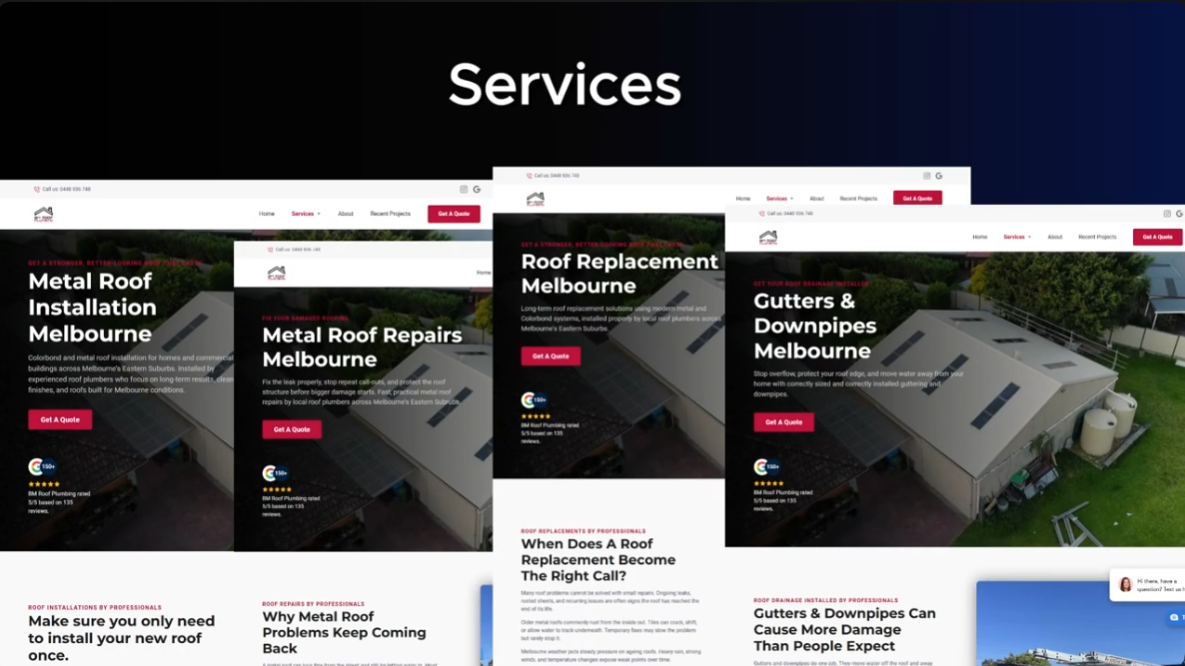
Step 2 — The "answer machine" website
Most tradie websites are brochures: a logo, a phone number and a list of services. We built the opposite — an answer machine that gives a customer everything they need before they ever pick up the phone.
That means hundreds of pages covering every service BM Roof Plumbing offers and every area they want to work in, backed up with real case studies. When you answer every question a customer might have, two things happen: customers arrive ready to book, and Google starts to trust the business. As that trust built, rankings and traffic exploded — search for a roof plumber anywhere in their area and Billy shows up. You can almost read the weather from his lead numbers; when it rains, the enquiries spike.
There's a newer payoff too. Because the site answers so many real questions in depth, BM Roof Plumbing now gets surfaced in AI search — the Google AI overview, and tools like ChatGPT, Gemini and Claude — recommended ahead of businesses that have been around for decades. That's an edge most local businesses haven't even realised is available yet.
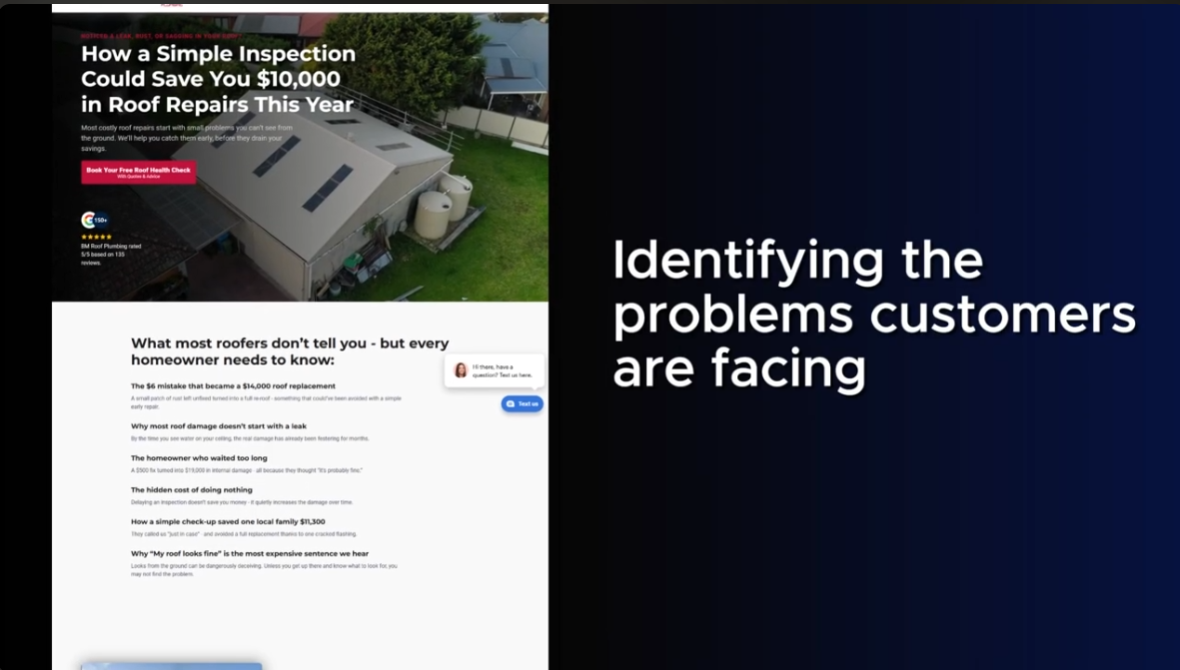
Step 3 — Problem-based Google Ads
Organic search is fantastic, but in a competitive area it takes time. Paid ads are how you turn the work up immediately — and here's where most local businesses get it badly wrong. They advertise their service. We advertise the problem.
A homeowner often doesn't know they need a "roof plumber." What they know is that water is dripping through the ceiling, there's mould spreading, or the roof is rusting. So we built campaigns around those exact problems, split into two that target very different buyers:
- Roof leaks — people with a smaller, urgent problem. Cheaper cost per lead, and great for filling gaps in the calendar and supporting cash flow. Plenty of these turn into full re-roofs once Billy diagnoses the real issue.
- Re-roofing — people who already know they need a new roof and are just looking for the right person. They cost a bit more per lead, but they book the big jobs.
Speaking to the problem is also why the conversion rates are so high. Instead of "we do roof plumbing," the ad meets the customer where they are:
"Water coming through the ceiling every time it rains? Mould in the roof? Gutters overflowing? Leave it and a $500 fix can become a $12,000 roof replacement. We'll come out, find exactly where it's coming from, give you a free quote — and if we don't fix it the first time, we'll come back and sort it."
Name the problem, raise the stakes of ignoring it, then hand over the full solution. That's the formula.
Did it actually make money? The numbers
Big lead numbers are nice, but the only question that matters is whether it paid off. Over 18 months, here's the full investment:
- $36,000 in management (building and running the whole system)
- $18,000 in Google ad spend
- $54,000 total — which produced 1,174 leads
That works out to roughly $45 per lead — for a business where a single job can be worth $20,000. That math is why BM Roof Plumbing could grow from a sole operator into a team of six with an office manager, a warehouse and a fleet of vehicles, doing over a million dollars in its first year and on track for two million this one.
Why it worked — and what you can take from it
The genuinely surprising part of Billy's growth is that none of it is revolutionary. No going viral, no TikTok trends, no AI automations. He just put a system in place so he consistently shows up when someone has a problem he can solve — then responds fast and does great work.
Every day, local businesses like this quietly grow into companies doing millions. If you want to do the same, the lessons are simple:
- Treat referrals as a bonus, not a plan. Build a pipeline you can rely on.
- Win the Google Business Profile by relentlessly collecting reviews — it compounds.
- Build a website that answers every customer question, not just a brochure.
- In your ads, sell the solution to a problem people are actually searching for.
- Show up, respond quickly, and do a good job. Most competitors don't.
Here's the opportunity: most local businesses are doing this badly, so the gap to catch the ones who've been around for 20 years is far smaller than it looks. Set the system up, get the work coming in, and a "boring" local business can make millions.